
Date: March 17, 2026
The display of art collection in a private setting is not merely a technical matter of placement. It is a spatial decision that creates atmosphere, directs the viewer’s gaze, and reveals relationships between works.
The hanging of newly acquired artworks is often a quiet dilemma. In a home that has evolved over the years—whether an apartment, a holiday house, or a pied-à-terre—each new piece enters an already organized, structured, and, above all, vibrant whole. Rooms have found their order, artworks relate to one another, and furniture defines movement and lines of sight.
Then a new piece is added. Perhaps because something was missing. Perhaps simply because you fell in love with it.
Suddenly, this balance is thrown off. Artworks are rehung, furniture is moved, proportions are reimagined. The new painting or sculpture brings—at least temporarily—a productive unease until a new place emerges.
Personal experience shows time and again: a work of art needs time. Often, it remains unhung at first. It is moved around the room, leaned against a wall, contemplated. Almost as if it were choosing its own place. Every work brings its own energy—and this often unfolds differently in a private context than in a gallery. After a certain time, it becomes clear where it belongs. And not infrequently, this means that other works must also relocate.
The situation is different when a new space is created. Moving into a new home opens up greater scope. Many of our collectors find themselves in precisely such transitional phases: they are building new homes, downsizing, or expanding, moving into a summer home, or setting up your children’s first place of their own. In these situations, art often plays a leading role. Artworks are deliberately placed, shaping spaces from the very beginning and defining their character.
Regardless of the context, however, one central aspect remains constant: the decision must feel just right. Authenticity is crucial. A work of art should not only fit in, but also inspire and accompany you—even if it hasn’t yet found a permanent spot and is simply leaning against the wall for the time being.
The ideas expressed in this article are therefore not meant to be rigid rules, but rather guidelines. They offer direction without being prescriptive. Because ultimately, what Pablo Picasso once said holds true: You must master the rules like a master in order to break them.
With that in mind: Enjoy the conscious placement—and the equally conscious breaking—of rules.
150-cm rule
The so-called 150-cm rule is often cited as a guideline: the center of a picture is positioned about 150 centimeters above the floor, roughly at eye level. This rule creates a calm visual line and works very well in many situations. Nevertheless, it remains a guideline. Especially with large vertical works, the relationship between the artwork and the wall shifts significantly. In such cases, it is often more effective to consider the proportions of the entire work within the space rather than strictly adhering to a specific measurement.
The 150-cm rule has its origins in professional exhibition hanging and serves as a reliable guideline for balanced visual flow. At the same time, it is repeatedly and deliberately challenged in artistic practice. In contemporary hanging, in particular, creatives use height as a targeted design tool. Depending on the subject—such as in figurative representations—a work can be positioned significantly higher or lower to enhance its impact, shift perspectives, or create a deliberately intriguing tension.
Symmetry. When does it work in favour?
The same applies to symmetry. It can create clarity and calm, particularly with pairs of works or series. However, overly consistent symmetry can also appear static. Slight shifts, varying distances, or deliberate asymmetries create tension and allow the eye to wander through the space. Hanging art therefore always involves composition.
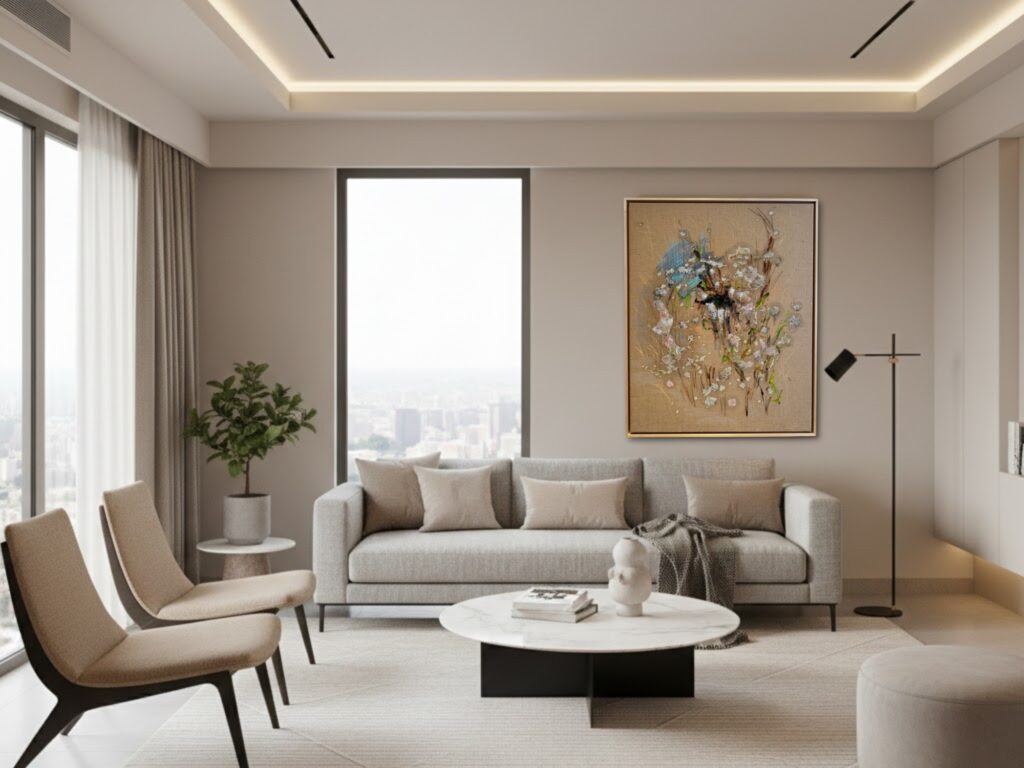
A visual anchor plays a central role here—a work that immediately defines the space. Such focal points provide orientation and shape the memory of a space. At the same time, a room can only accommodate a few such strong accents. Too many compete with one another. A carefully placed piece of art, on the other hand, can anchor an entire wall—sometimes even an entire room.
Hallway – an unexpected anchor to a welcoming space.
One area that is often underestimated in private collections is the hallway. It is precisely here that art has a special impact. The hallway is the place of welcome: guests enter the space and encounter the collection for the first time. At the same time, it is a passageway that one traverses again and again in daily life. Artworks are not merely viewed once here, but accompany movements, repetitions, and brief moments of attention. This creates a different form of perception—less contemplative, yet surprisingly present.
Ultimately, a compelling installation arises from the balance between rules and sensitivity to the space. The size of the works, light, wall surfaces, and the relationships between the works themselves form a structure that extends far beyond the individual placement. Hanging art therefore means not only placing works—but developing a spatial dramaturgy.
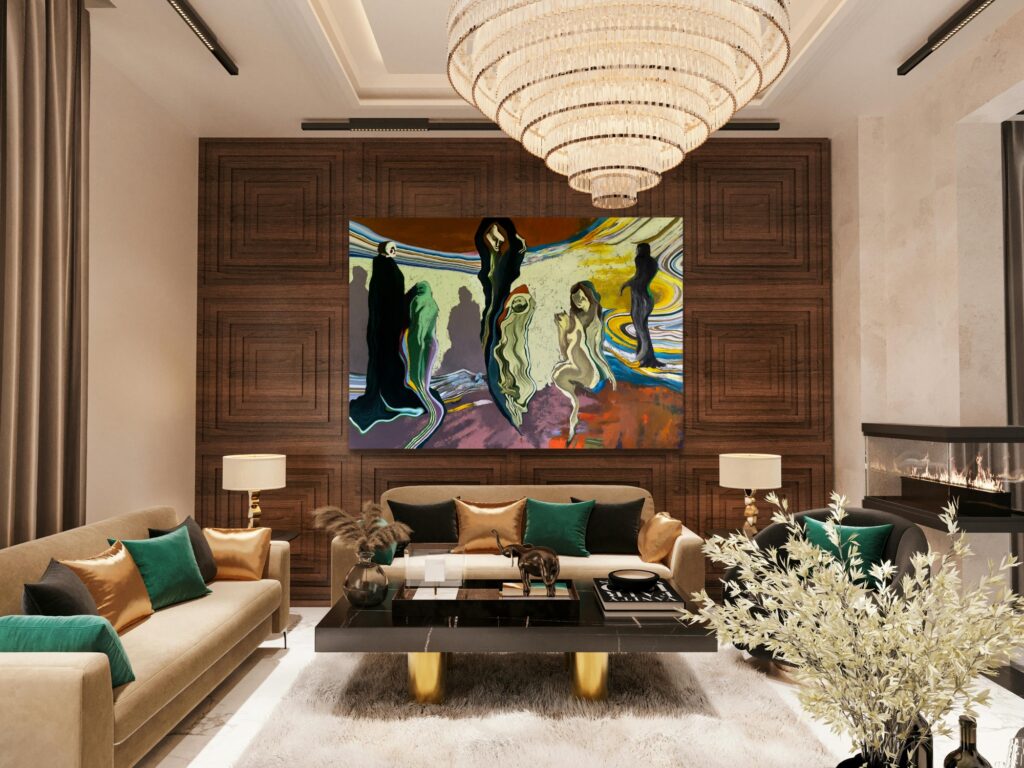
Salon hanging. Order amidst chaos for true collectors.
The so-called salon hanging is perhaps the most passion-filled form of presentation. Here, art takes over the space almost entirely. In such interiors, it becomes immediately apparent: here, people collect not strategically, but out of a deep, personal love for art.
Salon hangings embody a certain generosity. They speak of curiosity, of time, and of a continuous dialogue between works. Different formats, media, and positions meet on equal footing.
Yet even this seemingly free form follows its own principles. Without a certain degree of order, a salon hanging can quickly appear chaotic. An internal structure is crucial. It often helps to start with a central work and group the remaining pieces around it—similar to an organically growing composition.
Equally important is the balance between density and space. A helpful, often underestimated principle within salon hanging is that of an invisible cross. Here, small empty spaces are deliberately left along a horizontal and a vertical axis—which ideally intersect in the center of the wall. This “cross” gives the composition a clear internal order and makes it possible to combine a variety of works without the hanging appearing overloaded.
In practice, this principle is barely noticeable—and that is precisely where its strength lies. It works in the background, holding the composition together and making even complex arrangements appear surprisingly natural.
Salon hanging is less about staging and more an expression of an attitude: viewing art not as an individual object, but as a vibrant part of one’s own living space.
_____________________________________
At EXOgallery, we are more than happy to advise our collectors on how to best showcase their newly acquired works in their homes. Often, even small changes in how a piece is hung can significantly enhance its impact and give it the space it deserves.